

A story of culture, dignity, and the women who carry both.
A Ndebele year is measured in ceremonies. July brings the boy initiations, when sons return from the mountain as men and their communities gather to celebrate. August is Women's Month, and with it the celebrations that follow National Women's Day. September carries its own occasions, and December brings the weddings, the great family gatherings and the women's initiations. Through every one of these days runs a single, unbroken thread: the beads and the blankets. They are what a family reaches for when something sacred is happening.
That thread has a language, and the fluent can read it at a glance. Look at the women at any of these celebrations and the language grows richer still. The headpiece a woman wears is not decoration. It speaks. Its form and detail tell you her stature in the community, whether she is married, where she stands. A stranger could arrive at a gathering and, without a word exchanged, read a woman's place in the world from what she wears on her head. This is a culture that writes itself in beadwork, and the women are both its authors and its living text.
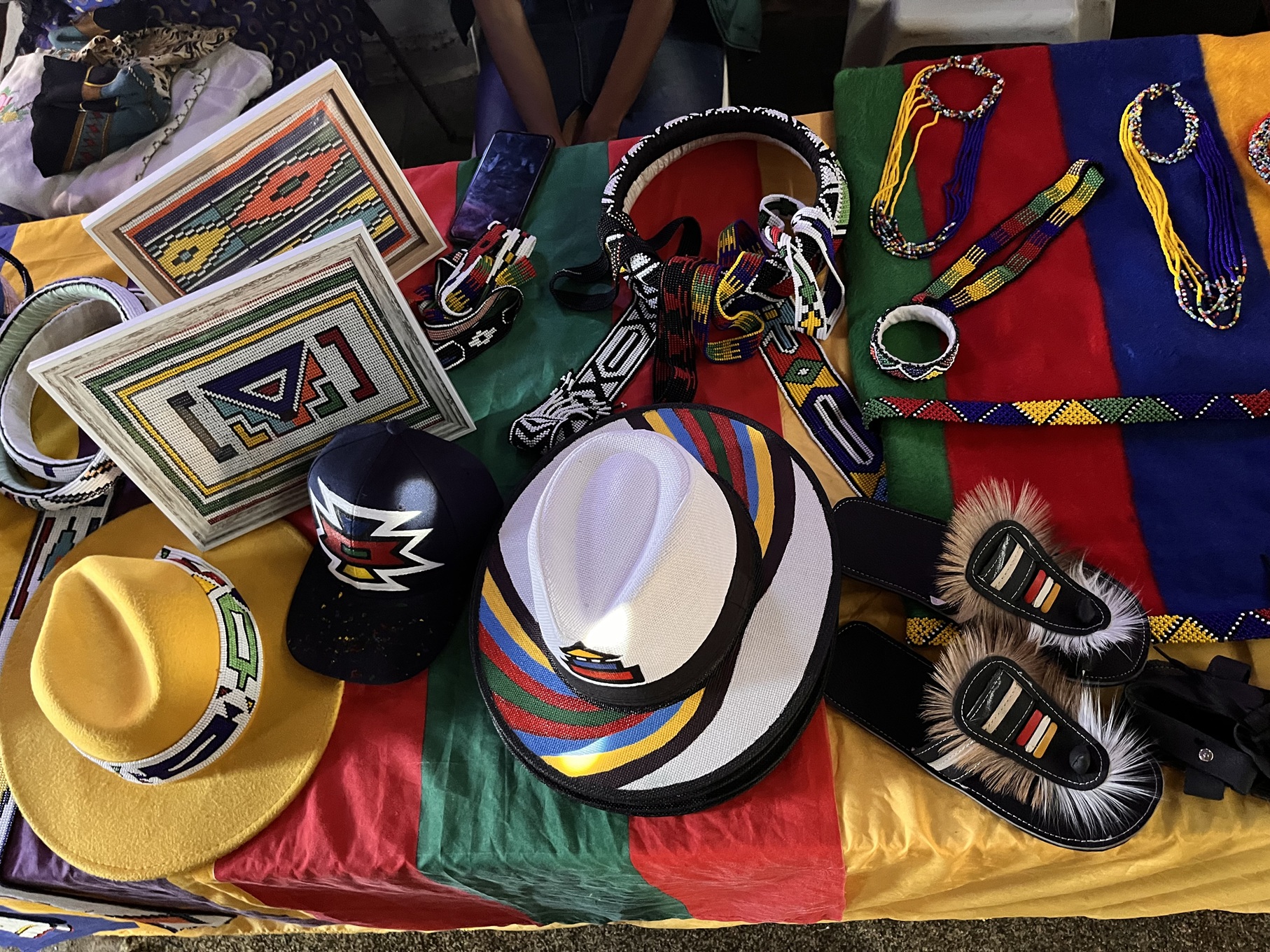
Every colour carries meaning. Every pattern is a sentence. Beadwork runs through the whole of Ndebele life, from the everyday to the sacred. Ndebele women have long used it, the imincamo, alongside their painted walls, as a visual language of their own, a way to express marital status, resilience and community pride when words were not needed. The ceremonial headpiece, the mlingakobe, carries that same weight of identity in the thickness of its work. Nothing here is craft for its own sake. It is memory, belonging and status, held in the hands of women and worn on the bodies of a people. And because these ceremonies return year after year, the need for beads and blankets returns with them, a living culture with a living economy, waiting to be brought home.
And for generations, those hands have done this sacred work largely unseen and unpaid. Worse, the materials of the tradition had drifted away from home. The blankets were imported. The beads were imported. A culture's most sacred visual language was being manufactured somewhere else, while the women who keep it alive were left outside its value.
This is where our story begins. And there is no better day to begin it than this one, National Women's Day, alongside Queen Miriam Thembi Mabena.
Changing hearts and minds
There is a phrase we keep returning to in this work: changing hearts and minds. It sounds soft until you sit with what it actually asks of you. To change a heart, you have to honour what a person holds sacred. To change a mind, you have to prove that honouring it and building a future from it are the same act, not competing ones.
Siyakha Heritage is built on that conviction. It began with a question about dignity as much as economics. Why should the women who hold a culture be invisible within it? It began with a question about dignity as much as economics. Why should the women who hold a culture be invisible within it?
Our answer rests on a belief we carry into all of our work. Real change means creating an environment where individuals, small businesses and rural communities can sustain themselves independently, breaking cycles of dependency. It is not something handed down. It is a capacity built up, until the people who hold it no longer need us at all.
That belief shapes the method, and the method has a shape we know well. We build the bridge. We do not walk anyone across it. We build access, and the community decides how to cross. And we do it in the community, with the community, for the community, by the community, because a heritage cannot be preserved from the outside. It can only be carried forward by the people to whom it belongs.
Bringing the craft home, layer by layer
The instinct in development work is often to arrive with a solution. Ours is the opposite. We arrive with a question, and we listen before we build. What the Ndebele community holds is not a problem to be solved. It is an asset to be honoured, and an economy waiting to come home.
So the work is deliberate, and it moves in layers.
The blankets, once imported, are being localised, manufactured closer to home so that the value stays with the people who wear them. The beadwork, long done for love and never for livelihood, becomes paid work for the Heritage Protectors who have always done it. And the beads themselves, the umncamo at the very heart of the craft, are next. We are exploring how they can be made locally from recycled glass and reclaimed material, so that in time even the raw ingredient tells a story of dignity and sustainability. A culture that once imported its identity will, layer by layer, manufacture its own, from the ground up, by its own hands.
Around this sits everything Siyakha has learned in nearly three decades of community work. We do not run projects and leave. We use a delivery model, proven in our earlier work, where the community itself drives the enterprise: local women taking orders, fulfilling them, reinvesting, and building a business that belongs to them rather than to us. We connect the craft to tourism, to design, to markets far beyond the village, so that a headpiece made in Mpumalanga can find an admirer in Cape Town, or Milan. And we hold every part of it to the same standard we hold all our development work to: does it educate, does it create income, does it build enterprise, and will it stand on its own when we are gone?
Preserving the culture and honouring the women are not two goals. They are one. The income exists to serve the culture, and the culture is kept alive by women who can now hold their heads high while they carry it.
The women leading it
Central to this work are the women we call Heritage Protectors: the custodians of the craft, the keepers of the knowledge, the hands that have kept this tradition alive through every generation. More than ten of them are already part of the pilot, with many more of the community's beading women to follow.
The word matters. They are not beneficiaries of a programme. They are protectors of a heritage, and the distinction runs through everything we do. One frames a person as someone things are done to. The other frames her as someone who holds something precious that the rest of us need. The Heritage Protectors are the second kind, and always will be.
Alongside them stand our Community Queens, young people from the area stepping into roles that connect the project to the community it serves. This is deliberate. Heritage is not preserved by keeping it still. It is preserved by handing it forward, from the women who hold it now to the youth who will carry it next. Dignity, passed down like a pattern.
The Queen herself has set the tone for this work, and for the invitation it extends:
"As the Ndebele Queen, I support all efforts to improve the lives of our people, to help them build a secure future, and to assist in bringing more exposure to their art, opening doors to a larger audience. Let's work together to achieve this." —Queen Miriam Thembi Mabena
Read her words again, because they hold the whole strategy in a sentence. Improve lives. Build a secure future. Bring exposure to the art. Open doors to a larger audience. She is not asking for charity. She is describing an economy, and inviting the world to help build it.


The first threads
The end of July 2026 brought the soft launch of the pilot. It was, in every sense, a quiet beginning: the first threads of something we intend to grow with great care. There were beads and blankets. There were Heritage Protectors. And there was a community seeing its own culture reflected back not as a museum piece behind glass, but as a living tradition with a future, and with dignity restored to the hands that make it.
We are keeping our numbers honest. The vision is large, hundreds of community members drawn in, thousands of blankets, real livelihoods rooted in real culture, and we will report on those as they are earned, never before. What we can say today is that the work has begun, the women are beading, and the first bridge is being built.
Why this is only the beginning
South Africa is not one culture. It is many, each with its own craft, its own colour, its own language of belonging worth telling and worth honouring. The Ndebele Beads and Blankets pilot is the first, deliberately so. We wanted to prove the model with care, and with respect, before we spoke about scale.
The ambition, though, was never a single community. It is a country's worth of heritage, preserved not behind glass but through the dignity and the livelihoods of the people who own it, one culture at a time. Every craft has its keepers. Every keeper deserves what the Heritage Protectors of Mpumalanga are beginning to claim: recognition, income, and pride in work that was always sacred and is now, at last, seen.
The official launch comes in September. Consider these the first threads of a much larger story.
A note for those who build alongside us
Work like this does not happen alone, and the Queen's invitation is a real one. As the pilot grows toward its September launch, so does the opportunity for partners, funders and corporates who understand that meaningful transformation and genuine cultural preservation belong in the same place.
There is a reason this model appeals to organisations serious about impact. It is built on localisation and sustainability from the ground up. Every layer we bring home, the blankets, the beadwork and in time the beads themselves, keeps value inside the community instead of sending it offshore. Local bead production from recycled glass and reclaimed material is the next layer we are working towards, and it would give the craft an environmental story as strong as its cultural one. The direction is a genuinely circular enterprise: local materials, local hands, local ownership, and income that recirculates through the community with every ceremony that comes around. For a funder, this is social investment measured in jobs created, skills transferred and culture preserved, with waste diverted as the layer we are building towards.
The result is enterprise that is genuinely circular: local materials, local hands, local ownership, and income that recirculates through the community with every ceremony that comes around. For a funder, this is social investment that can be measured in jobs created, skills transferred, culture preserved and waste diverted, all at once.
For organisations seeking exactly that kind of authentic, measurable, dignity-rooted investment, Siyakha Heritage is a story worth being part of, early. This is the work our byline was written for: business and investment excellence with local relevance, that's how we're making development happen©.
Together, we can be a part of making development happen©
Want to know more, or explore partnering with us? Contact the Siyakha Heritage team at:
